
Air India CEO and MD Campbell Wilson has resigned after four years at the helm, prompting the airline to form a committee to find his replacement. Wilson's tenure saw significant changes, including the merger of airlines and fleet expansion, but also faced challenges such as the London-bound flight crash and safety concerns.

The government has not taken any decision to privatise Air India, however, it was close to finalising a short-term strategy to strengthen the burgeoning civil aviation sector, including slashing taxes on jet fuel.

India's privatisation push, once projected as a cornerstone of economic reform, has suffered another setback, with the Centre set to call off the IDBI Bank stake sale, highlighting the political and structural constraints shaping the country's disinvestment policy, experts say.

'Air India's privatisation is acceptable as long as its control does not pass on to a foreign entity,' says A K Bhattacharya.
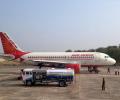
Air India will no longer enjoy a priority in allocation of international traffic rights. This follows its takeover by Tata Sons in January. The Directorate General of Civil Aviation has dropped a clause which gave Air India an advantage over other private airlines in the amended rules issued on April 19.

Loss-making government carrier Air India should be partly privatised, as private investors would focus on maximising profit and, in turn, solve the carrier's operational issues, a study commissioned by the corporate affairs ministry has said.
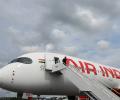
Consider this: despite a traffic of over 130 million passengers flying international-to-international (I2I) routes per annum over India, only one-sixth of the long-haul traffic (26 million) emanates from the country.
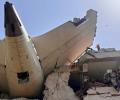
The DGCA has issued multiple fines and warnings to Air India over the past three years, flagging serious concerns in flight operations, cockpit discipline, and internal accountability.

Changing tracks helps. But, not taking the beaten path isn't always helpful. This is the story of two of India's biggest privatisations - Air India and Bharat Petroleum (BPCL). Nearly two decades after the last privatisation, a landmark divestment concluded this year when the loss-making national carrier Air India was sold to the Tatas.
Air India has covered a lot of ground since privatisation and its global coverage will further increase in the years ahead, the airline's chief Campbell Wilson said on Wednesday. He also said the interior refit of the single-aisle fleet, serving domestic and short-haul international destinations, is underway, and will be completed by mid-2025.
Air India sale will give a boost to India's privatisation drive, the Economic Survey said on Monday, as it suggested redefining the public sector role in business enterprises to encourage private participation in all sectors. The government earlier this month handed over ownership rights in national carrier Air India to Tata Group for Rs 18,000 crore. The amount includes the takeover of the debt burden of Rs 15,300 crore and another Rs 2,700 crore in cash.

Air India said on Monday that it has processed passengers refunds of more than Rs 150 crore during the first few months after its privatisation. After winning the bid for Air India on October 8 last year, the Tata Group took charge of the airline on January 27. Since then, the airline has been taking multiple steps to address the legacy issues such as stuck refunds.

'The real story of 2025 is that India officially stopped being a 'market of the future' and started acting as the world's primary economic engine.'
Crying foul, the Opposition on Friday alleged in the Lok Sabha that there was a deliberate design to make state carrier Air India bankrupt in order to privatise it, prompting the government to rule out privatisation and promise administrative and monetary steps to turn it around.
Tata was speaking to reporters after he, along with Singapore Airlines CEO Goh Choon Phong and Tata-SIA Airlines Chairman Prasad Menon, met the minister.
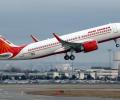
'The Modi government is trying hard to see if it could be sold to a private airline.' 'But it appears there are no takers.' 'If no buyer comes forward by June, the government will close down Air India,' predicts A K Bhattacharya.
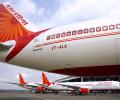
In a LinkedIn post on Wednesday, February 15, night, Nipun Aggarwal had said Air India, in addition to the order of 470 planes, had the option to purchase 370 aircraft from Airbus and Boeing.
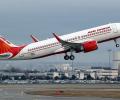
India's largest public sector bank State Bank of India (SBI) will support Tata group's bid for soon-to-be-privatised Air India by subscribing to Tata Sons debentures or funding the special purpose vehicle (SPV) set up by Tata Sons for the acquisition. Bankers said the credit rating of Tata group's holding company is "AAA" signifying high safety and a combination of Air India with its existing airline businesses would make it a formidable player - leading to a duopoly market with IndiGo. It would also open many business opportunities, including in the retail segment, an official said.

After more than two decades and three attempts, the government has finally sold its flagship national carrier Air India, and it is deja vu for Maharaja as it returned home to its founding father the Tata group. Jehangir Ratanji Dadabhoy (JRD) Tata founded the airline in 1932 and named it Tata Airlines. In 1946, the aviation division of Tata Sons was listed as Air India, and in 1948, the Air India International was launched with flights to Europe. The international service was among the first public-private partnerships in India, with the government holding 49 per cent, the Tatas keeping 25 per cent and the public owning the rest. In 1953, Air India was nationalised and for the next over four decades it remained the prized possession for India controlling the majority of the domestic airspace.

Passengers of a San Francisco-bound Air India flight faced a harrowing time due to an inordinate delay and some of them fainted as the aircraft's air-conditioning system was non-functional.
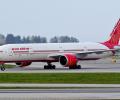
They say better late than never. For the Tatas, the original owners of Air India, bringing back the airline to its fold is worth the wait even if the attempt to privatise the bleeding national carrier by successive governments has taken over two decades. While many airlines have come and gone from the Indian skies since the time when the first move was made to privatise Air India to date, the salt-to-software conglomerate has never let the love affair with aviation, more so with Air India that its former chairman Jehangir Ratanji Dadabhoy Tata (JRD) had, to go off the radar. It is said that Tata group executives used to complain in private that JRD -- the pioneer of the Indian aviation industry -- spent more time worrying about Air India than the Tata group when he was heading both the entities.

The government will start working on selling the ground-handling arm of erstwhile national carrier Air India and the Expression of Interest (EoI) is expected in the next fiscal, an official said. "We already have the Cabinet approval for selling the subsidiaries of Air India. "So we will come out with an EoI inviting bids for one of the ground-handling arms in the next fiscal," an official told PTI.
Cash-strapped Air India should be run by professionals even if the government partially off-loads its stake to investors to keep it off-the-ground, a top global aviation professional has said.

But selectively, with regulatory scrutiny and special approval, points out Tamal Bandyopadhyay.
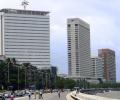
With over Rs 55,000 crore debt, Air India management has been trying to pare burden by monetising non-core real estate properties.
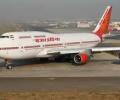
Pusapati was given detailed presentations on various aspects of the sector by senior officials of the Ministry.

The cost of any flight from Delhi and Mumbai could rise by up to Rs 3,000 soon unless the airport regulator is able to reverse a court order.

Two aborted missions, three different ministers, multiple rule changes and two decades later, Indian taxpayers will no longer have to pay Rs 20 crore per day to keep the loss-making Air India flying. While opposition Congress expectedly attacked the decision as selling the family silver, DIPAM secretary Tuhin Kanta Pandey said what Tata is getting is not a cash cow but an airline which is bleeding where money needs to be pumped in to refurbish obsolete aircraft and dust up strangled ones while being unable to touch any employee for one year and only be able to resize staff after paying a VRS. "It won't be a very easy task there. Only advantage is they (new Air India owner) are paying the price which they think they can manage. "They are not taking the excessive debt accumulated to fund years of losses. We are continuing it as an ongoing concern.... This process has also saved huge amount of taxpayers money going forward," Pandey told PTI.
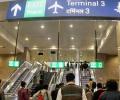
With better utilisation of slots, foreign flying rights, and greater international connections, the operator of India's largest airport feels a privatised Air India will bring commercial benefit to Delhi airport and help it revive quicker from the pandemic shock. Delhi is the largest hub for Air India, with most of its long-haul flights to the US and Europe being operated from here. The airport plans to give its most modern terminal 3 (T3) exclusively to the Tata Group.
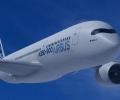
Planemakers have started pitching their latest aircraft to a privatised Air India which has been acquired by salt-to-steel conglomerate Tata Sons. European aerospace major Airbus on Monday said that it is in talks with the airline to sell its long haul aircraft Airbus A350-900. The wide-body aircraft is capable of flying non-stop between India and United States- one of the most popular and revenue generating routes.

The government is looking at a new timeline for Air India disinvestment and financial bids will be invited in the coming days, Union minister Hardeep Singh Puri said on Friday. Noting that there is no choice but to either "privatise or close" Air India, he said the government will have to keep the airline running till it gets divested. "We are looking at another timeline now, what is called data room for prospective bidders to look at... that is opened up, 64 days for the financial bids to come in. "After that it is the question of taking a decision and handing over the airline," the Minister of State for Civil Aviation said.
'The business continuity clause will mean the Tatas will have to keep running the airline for three years, and cannot exit the flying business.'
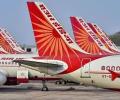
Tata Group-owned Air India has placed an order for 840 planes with Airbus and Boeing, including the option to acquire 370 aircraft, with a senior airline official on Thursday saying the order is a "landmark moment" in the Indian aviation history. The announcement by Air India's Chief Commercial and Transformation Officer Nipun Aggarwal comes a day after the airline said it has placed a firm order for 470 aircraft -- 250 from Airbus and 220 from Boeing. In a LinkedIn post, Aggarwal said the airline is humbled by the excitement generated across the world by the airline's aircraft order.

The central government has agreed in-principle to Air India employees' main demands. It fears an industrial dissension now could impede the process of privatisation. It has agreed to bear the cost of liquidation loss on account of transfer to the Employees' Provident Fund Organisation (EPFO) from company-owned trusts, inclusion of employees in the central government health scheme (CGHS), and encashment of leaves. The template of the Air India process will be followed for other public sector undertakings up for privatisation at a later date.

The crash has dealt a blow to the conglomerate's efforts to turn around Air India, especially following its merger with Vistara in 2024.

With general elections on the horizon, the government's privatisation bandwagon has almost but stalled as a government wary of being accused of selling family silver opts for minority stake sales on stock exchanges over outright privatisation. The result -- the divestment target for current fiscal year is again likely to be missed. Big ticket privatisation plans such as that of Bharat Petroleum Corporation Ltd (BPCL), Shipping Corporation of India (SCI) and CONCOR are already on the backburner and analysts feel meaningful privatisation can happen only after April/May general elections.

The best course for the government at this time would be to tighten the seat belt a little more, without compromising on its investments in creating better infrastructure and giving a push to privatisation, points out A K Bhattacharya.

'The target for next year is unlikely to be more than that of this year. The more you divest in any cycle, the less your potential pipeline for the next,' said an official. 'The first two issues we want to tackle and complete in FY20 are Air India and Hotel Ashok.'
The government has initiated the process for inviting financial bids for the sale of national carrier Air India and the deal is likely to conclude by September, sources said. Salt-to-software conglomerate Tata Group was among the "multiple" entities that had put in preliminary bids for buying loss-making Air India in December last year. The sources said that after analysing the preliminary bids, eligible bidders were given access to the Virtual Data Room (VDR) of Air India, following which investors' queries were answered.
Air India on Monday said it will lease 12 more aircraft comprising both A320 neo and Boeing 777, which are expected to be inducted in its existing fleet in the first half of 2023. The new planes will be deployed on the airline's short, medium and long-haul international routes, Air India said in a statement. Air India said it has leased 42 aircraft since its privatisation in January this year.
 © 2026 Rediff.com - Advertise with us - Disclaimer - Privacy Policy - Sitemap - Feedback - About us - Terms of use - Grievances